
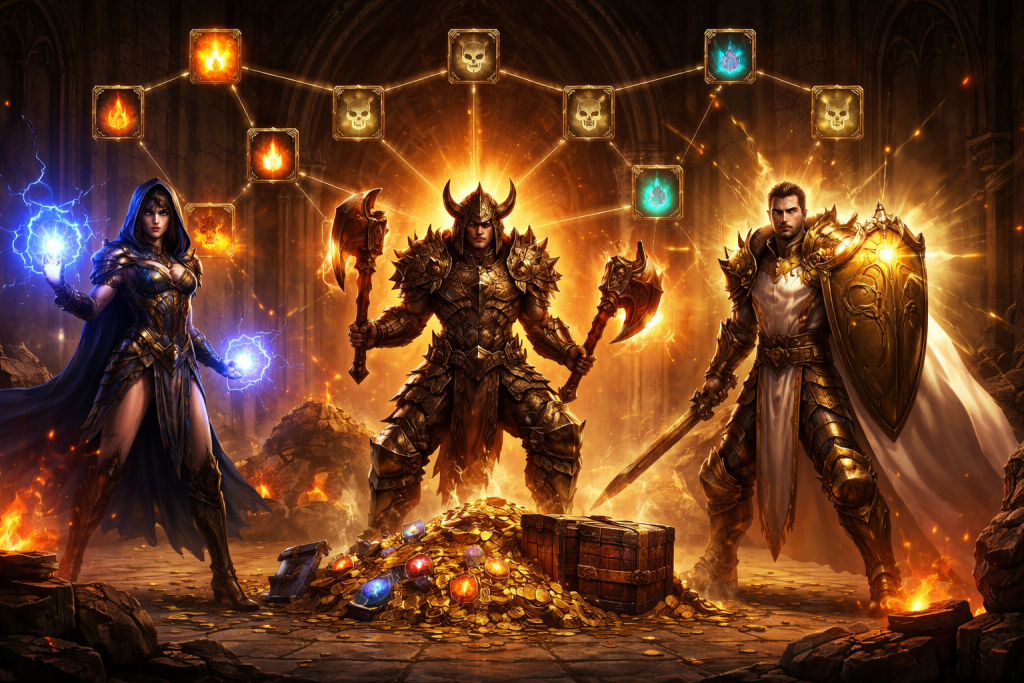
If you’ve spent any time in Diablo II or its modern remaster Diablo II: Resurrected, you already know how much your character build matters. Every skill point you spend can completely change your gameplay experience, efficiency, and endgame performance.
That’s why players increasingly rely on a Diablo 2 skill planner or D2R skill planner to design optimized builds before committing in-game. These tools take the guesswork out of character progression and help you build smarter from the very beginning.
In this guide, we’ll break down how skill planners work, why they’re essential, and how you can use them to create powerful, efficient builds in one of the most complex ARPG systems ever made.
What Is a Diablo 2 Skill Planner?
A Diablo 2 skill planner is a build simulation tool that allows players to plan their character’s skills before using them in the game. Instead of spending points blindly, you can map out your entire build from level 1 to endgame.
This is especially useful in Diablo II because skill choices are permanent or limited in flexibility, depending on your respective options.
A typical skill planner includes:
- All playable classes (Amazon, Sorceress, Necromancer, Barbarian, Paladin, Druid, Assassin)
- Full skill trees for each class
- Level-based progression system
- Synergy calculations between skills
- Build saving and sharing options
It acts as a blueprint for your character, helping you avoid mistakes and build efficiently.
Why a D2R Skill Planner Is So Important
In Diablo II: Resurrected, planning is more important than ever. While respec options exist, they are limited, especially in early gameplay. This makes planning ahead extremely valuable.
Here’s why a D2R skill planner is a must-have tool:
1. Prevents costly mistakes
A single wrong skill investment can slow your progress significantly or weaken your endgame potential.
2. Improves build efficiency
Planners help you maximize damage output, survivability, and synergy bonuses between skills.
3. Supports experimentation
You can test multiple build ideas without creating new characters every time.
4. Saves time
Instead of trial and error, you follow a clear and optimized path from the beginning.
How Diablo 2 Skill Planning Works
A skill planner simulates the real mechanics of Diablo II. It includes:
- Skill prerequisites (unlock requirements)
- Synergy effects between abilities
- Scaling based on level
- Build progression from early to late game
For example, if you’re building a Sorceress, investing in Fire Bolt may increase Fire Ball damage due to synergy bonuses. A planner shows these relationships clearly so you can optimize your build.
This removes uncertainty and helps you understand exactly how your character will perform at higher levels.
Popular Builds You Can Create with a Skill Planner
A Diablo 2 skill planner allows you to experiment with all kinds of powerful builds. Some of the most popular include:
Sorceress Builds
- Blizzard Sorceress for high-efficiency farming
- Lightning Sorceress for fast endgame clearing
- Fireball Sorceress for early leveling power
Paladin Builds
- Hammerdin focused on Blessed Hammer damage
- Smiter designed for boss fights and Ubers
- Zealot for fast melee combat
Necromancer Builds
- Summoner Necromancer using minions for control
- Poison Nova Necromancer for area damage
- Bone Spear Necromancer for precise high damage
Barbarian Builds
- Whirlwind Barbarian for melee clearing
- Berserk Barbarian for magic-based damage
- Find Item Barbarian for farming loot
Amazon Builds
- Lightning Fury Javazon for crowd clearing
- Bowazon for ranged physical damage
Druid and Assassin Builds
- Wind Druid using tornado-based spells
- Trapsin Assassin focusing on trap damage
Each of these builds can be fully optimized before entering the game using a planner.
Common Mistakes Without a Skill Planner
Players who skip planning often run into avoidable problems such as:
- Investing too many points in weak early-game skills
- Ignoring synergy bonuses between abilities
- Poor attribute distribution (strength, dexterity, vitality, energy)
- Building hybrid characters that lack focus
- Using respecs too early and running out of flexibility later
These mistakes can significantly reduce your character’s effectiveness, especially in higher difficulty levels.
Benefits of Using a Modern D2R Skill Planner
Modern skill planners offer much more than basic point allocation. Many include advanced features like:
- Visual skill trees for easier planning
- DPS estimation tools
- Gear compatibility insights
- Mobile-friendly interfaces
- Build saving and sharing options
- Community-tested build templates
This makes them essential for both beginners and advanced players.
How to Use a Skill Planner Effectively
To get the most out of a Diablo 2 skill planner, follow these steps:
Step 1: Decide your end goal
Choose whether you want PvE farming, PvP dueling, or boss killing efficiency.
Step 2: Select your class
Each class has a unique playstyle and scaling system.
Step 3: Plan backward from endgame
Start with your final build and work backward to early levels.
Step 4: Focus on synergy
Make sure your main skills are fully supported by synergy bonuses.
Step 5: Balance survivability
Don’t ignore defense, resistances, and utility skills.
Why Diablo II Remains Build-Focused
Diablo II is still one of the most build-intensive ARPGs ever created. Unlike modern games with frequent respecs and flexible systems, Diablo II rewards planning and long-term thinking.
Because of this, players constantly refine their builds using skill planners, especially when new ladder seasons or balance changes shift the meta.
This long-term depth is one of the reasons the game remains popular decades after release.
Who Should Use a Diablo 2 Skill Planner?
Skill planners are useful for a wide range of players, including:
- New players learning how builds work
- Returning veterans revisiting classic characters
- Hardcore ladder players optimizing efficiency
- Speedrunners trying to improve performance
- Farming-focused players maximizing loot efficiency
Even experienced players use planners to test new ideas before committing.
Frequently Asked Questions (FAQ)
1. What is a Diablo 2 skill planner used for?
A skill planner helps you design and simulate character builds before using skill points in the game, reducing mistakes and improving efficiency.
2. Is a D2R skill planner necessary for beginners?
Yes, it is highly recommended. Beginners often make irreversible mistakes without proper planning, which can slow progression.
3. Can I change my build later in Diablo II: Resurrected?
You can respec a limited number of times using in-game systems, but it is not unlimited. That’s why planning ahead is important.
4. Do skill planners include all character classes?
Yes, most modern planners include all seven classes and their complete skill trees.
5. Can I use skill planners for endgame builds?
Absolutely. In fact, most players use them specifically for optimizing endgame farming and ladder builds.
6. Are skill planners accurate to the game?
Good planners closely match in-game mechanics, including skill synergies, prerequisites, and scaling.
Conclusion
A Diablo 2 skill planner or D2R skill planner is one of the most valuable tools for anyone serious about mastering Diablo II: Resurrected. It removes guesswork, prevents costly mistakes, and allows you to experiment freely with powerful builds.
Whether you’re a new player learning the basics or a veteran optimizing ladder performance, planning your build in advance gives you a major advantage in both efficiency and enjoyment.
In a game where every skill point matters, preparation is the difference between a weak character and a legendary one.
