
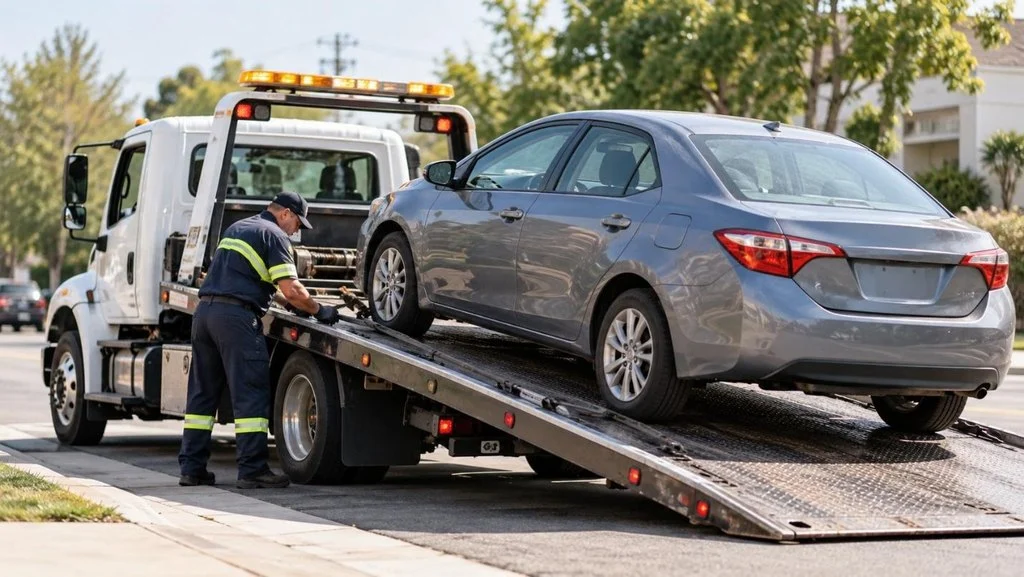
A vehicle does not have to be completely immobile before towing becomes the sensible option. In many situations, a car may still start and move but continuing to drive it could increase the risk of further mechanical damage, create a safety issue or make an already difficult situation worse.
Breakdowns, accident damage, restricted access and mechanical faults can all change the safest way to move a vehicle. Knowing when to stop driving and arrange professional transport can help protect both the vehicle and the people around it.
When a Vehicle Is No Longer Safe to Drive
Some vehicle problems are relatively minor and can be resolved at the roadside. Others are clear signs that the vehicle should not continue its journey.
Serious overheating, significant fluid leaks, damaged tyres, steering problems, brake faults and accident damage can all make driving unsafe. Even when the engine is still running, there may be underlying damage that becomes more severe as the vehicle travels.
Drivers should pay particular attention to unusual noises, warning lights, changes in steering or braking, smoke, strong smells and visible damage around the wheels or suspension.
Trying to travel the final few kilometres simply because the vehicle is still capable of moving can sometimes turn a relatively straightforward repair into a more expensive problem.
When Professional Towing Makes More Sense Than Taking the Risk
When there is genuine uncertainty about whether a vehicle can be driven safely, professional transport is often the more practical choice.
Using an experienced operator such as Underground Towing & Salvage allows a disabled or damaged vehicle to be transported without relying on it to complete the journey under its own power.
This can be particularly useful after a mechanical failure or collision, or when a vehicle needs to be taken directly to a workshop, storage facility or another destination.
The decision does not necessarily depend on whether the vehicle can move. The more important question is whether continuing to drive could place the vehicle, driver or other road users at unnecessary risk.
Difficult Locations Can Change the Situation
Where a vehicle has stopped can be just as important as what has happened to it.
Underground car parks, multi-storey parking areas, narrow driveways, steep access points and confined residential spaces can all make vehicle recovery more complicated.
A standard approach may not work when height clearance is limited or when there is little room to manoeuvre towing equipment. The same applies when a vehicle is positioned in a way that prevents straightforward loading.
Providing accurate information about the location before the tow is arranged is therefore important. Drivers should mention low ceilings, ramps, narrow entrances, locked steering or any other conditions that could affect access.
This allows the towing operator to understand the situation before arriving rather than discovering an access problem at the scene.
Some Vehicles Require Additional Care
Not every vehicle should be approached in exactly the same way.
Low-clearance cars, performance vehicles, motorcycles, modified vehicles and larger four-wheel drives may all require different handling considerations. The same is true for vehicles with damaged wheels, locked steering or drivetrains that prevent the vehicle from rolling normally.
The objective is not simply to move the vehicle from one place to another. It is to do so without causing avoidable damage during loading, transport or unloading.
Vehicle enthusiasts tend to understand particularly well how much mechanical details matter. For a lighter look at the motoring world, Puncafe’s collection of racecar puns covers everything from engines and garages to drivers and mechanics.
Protecting the Vehicle From Further Damage
Improvised towing methods can create problems of their own.
Incorrect attachment points can damage bodywork or suspension components, while dragging a vehicle that cannot roll freely may place additional strain on wheels, tyres or drivetrain components. Low vehicles can also suffer underbody or bumper damage if loading angles are not properly considered.
A professional towing operator can assess how the vehicle is sitting, whether it can roll and steer, and whether existing damage changes the way it should be moved.
That assessment becomes especially important after an accident because some problems may not be immediately obvious from outside the vehicle.
Expert Insight: Knowing When Not to Keep Driving
According to Joshua Harrison, Founder of Underground Towing & Salvage, one of the most important decisions after a breakdown or vehicle problem is recognising when continuing to drive is no longer worth the risk. A vehicle may still move under its own power while having a mechanical or structural issue that could worsen considerably on the road. In those situations, arranging professional transport can be more practical than attempting to reach the destination under the vehicle’s own power.
The principle is straightforward: being able to drive a vehicle does not necessarily mean it is sensible to do so.
What to Tell the Towing Company
Clear information can make the towing process considerably easier.
Before arranging transport, it helps to provide details such as:
- The vehicle’s make, model and approximate size
- Its current location and intended destination
- Whether the engine starts
- Whether the vehicle can roll and steer
- Any visible accident damage
- Damaged or locked wheels
- Low-clearance modifications
- Underground parking or height restrictions
- Any unusual circumstances around the recovery location
The more accurately the condition of the vehicle is described, the easier it is for the towing operator to determine what may be required.
This is particularly important when the vehicle is damaged or positioned somewhere with difficult access.
Common Mistakes When Moving a Disabled Vehicle
One of the most common mistakes is assuming that a vehicle is safe to drive simply because it still starts.
Drivers may also underestimate the significance of unusual noises, damaged tyres or changes in steering after an impact. A short trip under those conditions can potentially worsen existing damage.
Another mistake is attempting to move a vehicle with unsuitable towing equipment or using improvised attachment points.
Access conditions are also frequently overlooked. A vehicle stuck in an underground car park, for example, may require a different approach from one parked on an open roadside.
State and territory road authorities also impose requirements around vehicle safety and road use. Drivers should avoid treating an improvised tow as an automatic substitute for professional vehicle transport, particularly where the condition of the vehicle is uncertain.
Experience Matters in Unusual Recoveries
Based on Underground Towing & Salvage’s experience assisting motorists with breakdowns, vehicle transport and difficult-access recoveries, the appropriate solution often depends as much on the vehicle’s condition and location as it does on the distance it needs to travel.
A vehicle that needs to move only a few kilometres may still require careful handling if it has damaged suspension or cannot steer. Conversely, an undamaged vehicle being transported over a longer distance may present a relatively straightforward job.
Looking at the whole situation helps avoid treating every tow as though it were identical.
Making the Right Call
Professional towing is generally worth considering whenever driving the vehicle introduces unnecessary mechanical or safety risk.
That includes vehicles affected by significant breakdowns, collision damage, steering or wheel problems, as well as cars located in places where normal vehicle movement is difficult.
The safest decision is often made before the vehicle moves again.
Rather than asking only whether the car is technically capable of being driven, consider whether continuing the journey could make the situation worse.
Conclusion
Professional towing is not reserved solely for vehicles that are completely immobilised.
A car may still start, steer or travel under its own power while having a problem that makes further driving unwise. Mechanical faults, collision damage, difficult access and specialist vehicle requirements can all make professional transport the safer and more practical option.
When there is uncertainty about the condition of a vehicle, avoiding unnecessary driving can help prevent further damage and reduce risk. Assessing the situation first and arranging suitable transport where necessary is often the better choice than hoping the vehicle will make it to its destination.
