
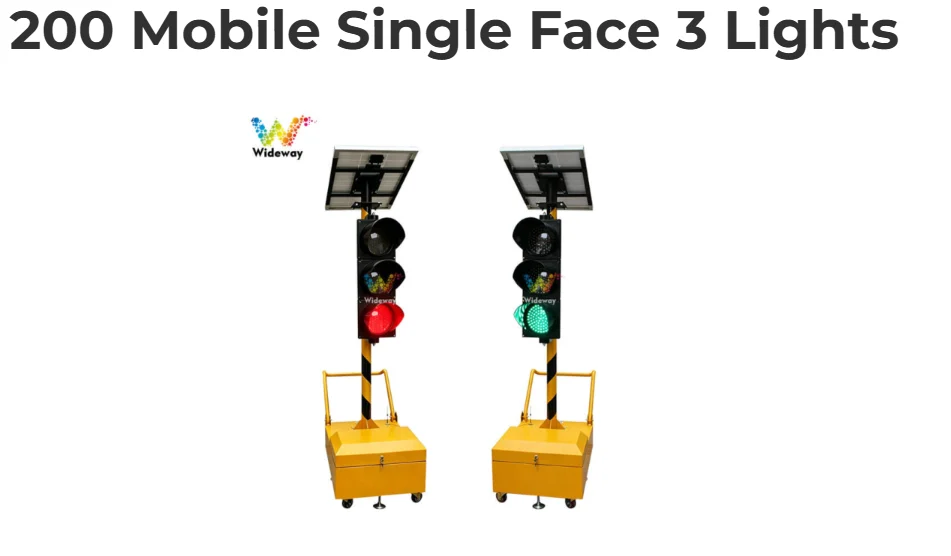
A road work site, a broken intersection, or a road that has no fixed signal yet all need the same thing: a traffic light that can be put up today, without digging up the road or laying cables. A 200 Mobile Single Face 3 Lights unit does that. It is a mobile, single-sided, three-light temporary traffic signal, made for emergency temporary traffic control at intersections.
Wideway, Shenzhen Wide Way Optoelectronics, offers this Model 200 mobile single-sided three-light unit. This article explains what it is, how it works, where it is used, and what a buyer should check before ordering one.
What Is It?
The Model 200 mobile single-sided three-light unit is classified as emergency temporary traffic control equipment for intersections. The whole system comprises a weighted mobile base, a vertical pole featuring warning black-and-yellow diagonal stripes, an LED signal head, a top-mounted solar photovoltaic panel, and a wireless remote controller.
Red, Yellow, and Green: How the Cycle Works
The red, yellow, and green LED signal lights operate in a cyclic sequence. Red light prohibits passage, yellow light serves as a warning, and green light permits passage. That is the same logic as a fixed traffic light, in a mobile form.
The LED light source offers high brightness and minimal light decay, ensuring clear visibility day and night and effective traffic guidance. The high-brightness LED beads ensure clear visibility from a distance even during daytime, and feature rain-and dust-proof protection, making them suitable for outdoor use.
Solar Power and Battery: No Mains Power Needed
The top-mounted solar panels automatically charge the built-in battery during daylight hours. No external 220V mains power is required. That is the first advantage of this unit. A temporary site often has no mains power, or the power is far away. A solar unit does not need a cable, a generator, or a connection to the grid.
An energy storage battery is installed inside the base housing, enabling continuous operation even on cloudy or rainy days and at night. The base is equipped with a lock to protect the battery, so it cannot be taken or tampered with easily. A 200 Mobile Single Face 3 Lights unit that can keep working through a cloudy day and through the night is a practical tool for a site that needs traffic control around the clock, not just in daylight.
Remote Control, Timer, and Emergency Warning
The unit is controlled by a wireless remote control. With a single button, an operator can easily switch between red, green, and yellow lights from a distance. That simple operation matters at a busy site, where the operator needs to change the signal without walking up to the unit.
In Emergency Warning Mode, the operator can activate flashing yellow lights with a single button, to warn passing vehicles to slow down. That mode is useful when a hazard appears suddenly, and drivers need a warning at once, without waiting for a full cycle.
Two Units Working Together: The Core Feature
The core feature of this unit is that two mobile traffic lights can communicate and operate in tandem. When two devices are deployed at a crossroads, wireless communication enables cross-traffic signal coordination. One device operates on red light while the other operates on green light, thereby simulating the signal logic for a crossroads, without the need to install communication cables.
A 200 Mobile Single Face 3 Lights pair that can do that, with no cables between the units, is a practical solution for a road construction site, an emergency intersection repair, or a new intersection where fixed signals have not yet been installed.
Where Is It Used?
This equipment is primarily deployed during road construction, emergency intersection repairs, temporary road closures, or when fixed signal devices have not yet been installed at an ongoing intersection. In all of those cases, it serves as temporary traffic control for vehicles and pedestrians.
A 200 Mobile Single Face 3 Lights unit that is lightweight, flexible, and easy to move can be placed wherever traffic control is needed, and moved again when the work moves.
How to Choose the Right One
A buyer should check five things before ordering. First, the lights: are the red, yellow, and green LEDs bright enough to be seen clearly, day and night, from a distance? Second, the power: does the solar panel and battery keep the unit working through cloudy days and at night, with no mains power?
Third, the control: can the phases be set easily by remote control, and can the unit switch to flashing yellow in an emergency? Fourth, the coordination: can two units work together wirelessly, with one on red while the other is on green, to control a crossroads? Fifth, the mobility: is the unit light enough to push into place by hand, on its casters, with no digging or wiring?
A 200 Mobile Single Face 3 Lights unit that scores well on all five points is a safer buy than a cheaper unit that is hard to move, hard to control, or unable to work through the night.
Conclusion
A temporary traffic signal is a simple idea with a clear job: to control traffic at an intersection that has no fixed signal, without digging, wiring, or waiting. The Model 200 does that with a weighted mobile base, a pole with black-and-yellow warning stripes, a three-light LED signal head, a top-mounted solar panel, a battery in a locked base, and a wireless remote control.
With solar charging, battery storage, a smart timer, an emergency flashing yellow mode, and wireless coordination between two units, it can control a crossroads as well as a fixed signal, for as long as the work lasts. For road construction, emergency repairs, temporary closures, and new intersections, it is a practical tool.
Frequently Asked Questions
1. What is this unit?
A mobile, single-sided, three-light temporary traffic signal, classified as emergency temporary traffic control equipment for intersections.
2. What does the system include?
A weighted mobile base, a vertical pole with black-and-yellow diagonal warning stripes, an LED signal head, a top-mounted solar panel, and a wireless remote controller.
3. How does it work without mains power?
Top-mounted solar panels charge the built-in battery during daylight, and the battery keeps the unit working on cloudy or rainy days and at night, with no external 220V mains power required.
4. Can two units control a crossroads?
Yes. Two units communicate wirelessly and operate in tandem, so one shows red while the other shows green, simulating crossroads signal logic without communication cables.
5. How is it controlled?
By a wireless remote control, with a single button to switch lights, a smart timer mode to set each phase duration, an emergency flashing yellow mode, and start or pause control.
