
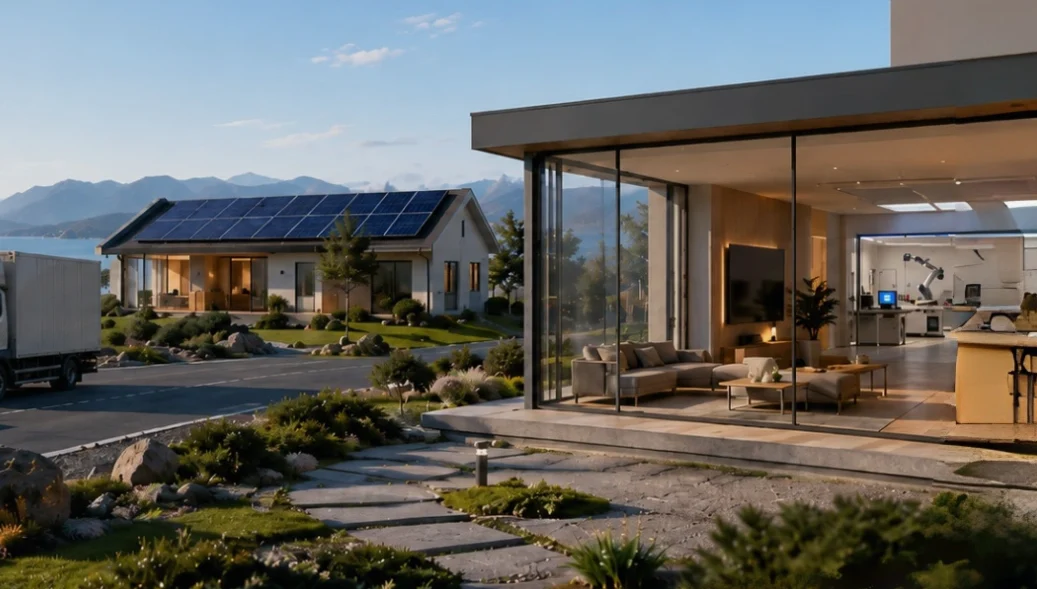
A cabin in the mountains, an RV on the road, a small house on an island: these homes have one thing in common. There is no municipal power grid to plug into, and every watt must come from the sun and the battery. dc appliances are made for exactly those homes. They run on the DC power the system already makes, so a small home can have light, cooling, cooking, and cleaning, without a big inverter and without a big battery bank.
KAM UNION, through its Off-Grid Residential Systems range, offers DC appliances for off-grid houses, cabins, RVs, and other constructions. This article looks at them from the point of view of a small, mobile, or remote home, and how to live with them day to day.
Small Homes Need Small Power
A cabin or an RV is not a city house. It is smaller, it has fewer rooms, and it has fewer appliances. That smaller size is an advantage for a DC system, because a smaller home needs less power, and a DC system can supply that power directly, without conversion.
Various residential and portable systems have various electrical requirements. A simple cabin or outdoor setup might just need basic lighting and ventilation, but an off-grid home or vehicle would require cooling, cooking, water pumping, and many other pieces of equipment. Hence, choosing the right kind of DC appliances and voltage is important to ensure proper operation.
Lighting, Cooling, and Ventilation in a Cabin
DC appliances are widely used in off-grid residential systems such as off-grid houses, cabins, RVs, and other constructions. They can fulfill various functions, including lighting, cooling, and ventilation. Those three functions are the daily needs of a small home, and they are the ones that matter most.
dc appliances that cover those three functions give a cabin or an RV the comfort of a normal home, in a form that fits a small, off-grid space.
Cooking and Cleaning on the Move
A home is not just light and cooling. It is also cooking and cleaning, and a cabin or an RV needs those too. KAM UNION offers DC refrigerators, cookers, air purifiers, LED lights, and vacuum cleaners to suit different off-grid systems, so a buyer can equip a whole small home from one range.
12V and 24V for Small Homes
The Off-Grid Residential range features professional 12V and 24V pure DC solar power, energy storage, and dedicated low-voltage residential appliances, customized for off-grid and remote living environments. Those are the voltages that fit a cabin or an RV, where the loads are small, the cables are short, and the battery is modest.
For bigger off-the-grid houses, or where several electrical loads have to be supplied, 48V systems work more efficiently and provide better performance in terms of energy distribution. They are chosen for applications involving longer cable lengths or bigger power consumption. A big house, with long cables and many loads, needs 48V. A small cabin or an RV, with short cables and few loads, does not.
Choosing the right voltage also concerns cable size, battery setup, and overall system reliability.
Living With DC Day to Day
dc appliances that are used every day, in a cabin or an RV, become part of the routine. The lights come on at dusk. The refrigerator hums through the night. The fan runs in the heat of the day. The cooktop makes dinner. That routine is the same as in a city home, but the power behind it is simpler, safer, and more efficient.
One-Stop Supply for a Remote Home
A remote home is hard to supply. The house, the power system, and the appliances must all arrive, and they must all work together. KAM UNION provides a one-stop integrated supply, with full-chain supporting services ranging from prefab residential structures and power generation and storage systems to low-voltage electrical appliances.
Planning a Cabin or RV System
Despite many benefits, proper planning is required for effective and secure use of DC power. A cabin or RV system should be planned before the appliances are bought, not after. That planning should cover the battery voltage, the power capacity, the daily energy consumption, and the application needs.
dc appliances that are bought without planning can be the wrong voltage, too powerful for the battery, or unable to connect to the distribution system. A buyer who plans first will get a cabin or an RV that works from the first day.
How to Choose the Right DC Appliances
A buyer should check five things before ordering. First, the voltage: does the appliance match the battery voltage, whether 12V, 24V, or 48V? Second, the power: does the power consumption fit the solar panels and the battery, so the system can supply it every day?
Third, the capacity: is the refrigerator big enough, is the cooktop powerful enough, and are the lights bright enough for the cabin or RV? Fourth, the connection: does the connection method fit the DC distribution system? Fifth, the starting current: is the starting current within what the system can supply, so the appliance starts reliably?
dc appliances that score well on all five points, and that fit the size and the use of the cabin or RV, are a safer buy than cheaper appliances that do not match the system, and that will fail on the road or in the mountains.
Conclusion
A cabin or an RV is a small home, but it needs the same daily comforts as a big home: light, cooling, ventilation, cooking, and cleaning. DC appliances provide those comforts in a form that fits a small, off-grid space, running directly on the DC power that solar panels make and batteries store, with no inverter, no conversion, and no wasted energy.
With DC refrigerators and freezers, induction cooktops, rice cookers, air purifiers, LED lights, and vacuum cleaners, in 12V, 24V, and 48V, a buyer can equip a cabin, an RV, or a remote home that is comfortable, safe, and self-sufficient, wherever it is, and however far it is from the grid.
Frequently Asked Questions
1. Are DC appliances suitable for cabins and RVs?
Yes. They are widely used in off-grid houses, cabins, RVs, and other constructions, for lighting, cooling, ventilation, cooking, and cleaning.
2. What voltage should a cabin or RV use?
Professional 12V and 24V low-voltage equipment is standard for smaller off-grid homes, cabins, and RVs, while 48V suits bigger off-grid houses with longer cables and bigger loads.
3. What DC appliances does a cabin need first?
LED lighting first, then a DC refrigerator and freezer, then fans and air purifiers, and then cooking appliances like an induction cooktop and rice cooker.
4. How does a cabin DC system work?
Solar panels feed a charge controller, which charges a battery bank, and DC distribution sends the power directly to the DC appliances, with no AC conversion.
5. How do I choose the right DC appliances for a cabin or RV?
Consider battery voltage, power capacity, daily energy consumption, and application needs, and check rated voltage, power consumption, capacity, connection method, and starting current for each appliance.
